
What is Salutogenesis?
Health Paradigm.

Aaron Antonovsky introduced in his 1979 book Health, Stress and Coping and expounded in many subsequent works.
Life experiences help shape one’s sense of coherence → a strong sense of coherence helps one mobilise resources to cope with stressors and manage tension successfully → helps determine one’s movement on the health Ease/Dis-ease continuum
“Sense of Coherence”—that grounded feeling when life feels understandable, manageable, and meaningful.
Salutogenesis is the scholarly orientation focusing attention on the study of the origins of health and assets for health, contra the origins of disease and risk factors.
Paradigm shift from Pathogenesis → Salutogenesis
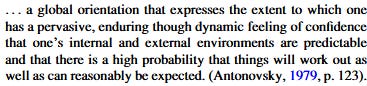
‘What makes people healthy?’
4 aspects of the salutogenic model that require attention are mostly neglected: -
Origins of the sense of coherence
Other answers to the salutogenic question than the sense of coherence
Health defined as something other than the absence of disease
Processes linking the sense of coherence and health
That factors (presumably besides the sense of coherence) intervene between the stress/resources complex on the one hand and the experience of health on the other hand

the axiom . . . which is at the basis of the pathogenic orientation which suffuses all western medical thinking: the human organism is a splendid system, a marvel of mechanical organization, which is now and then attacked by a pathogen and damaged, acutely or chronically or fatally” (Antonovsky, 1996).
Challenging this axiom, Antonovsky summarizes the essence of the salutogenic orientation in contrast to the pathogenic orientation (Antonovsky, 1996):
In contrast to the dichotomous classification of pathogenesis into healthy or not, salutogenesis conceptualizes a healthy/dis-ease continuum.
In contrast to pathogenesis’ risk factors, salutogenesis illuminates salutary factors that actively promote health.
In contrast to focusing on a “particular pathology, disability or characteristic” of a person, salutogenesis might work with a community of persons and “must relate to all aspects of the person”
Salutogenesis in Context: Comparable Concepts and Developments
The salutogenic model was inspired by stress and coping theories, notably Selye’s and Lazarus & Cohen’s work.
As does the salutogenic model, Lazarus and Cohen’s transactional model of stress assumes an interaction between external stressors and a person who evaluates stressors based on the resources available to cope.
It shares common ground with models like:
Job Demand-Control Model
Effort-Reward Imbalance Model
Job Demands-Resources Model
Share with the salutogenic model the basic idea of a balance between stressors and resource.
Salutogenesis connects with broader positive health and well-being movements seen in: -
Philosophy - Aristotle’s reflections hedonic and eudaimonic qualities of (positive) health
Positive organisational behaviour in organisational psychology
Happiness in management research
Place as a resource in social ecology
Promoting strengths in educational sciences
Pre-conditions for substantially rewarding, satisfying and fulfilling lives in sociology
In the health promotion, the positive paradigm may be seen in 2 types of literature:
Describes protective factors against untoward outcome
Describes factors that promote well-being
Thots:
Salutogenic thinking should be the way we think, rather than pathogenic. It's not simply about the presence of germs or external threats, but about the body’s ability to adapt, regulate, and maintain balance. Symptoms often reflect a system under strain, not just an invader to eliminate.
As they said “Prevention is better than cure”. It should be a healthcare not sickcare system.
Thinking in terms of healthy/dis-ease continuum, rather than healthy or not.
Thinking in terms of “What makes people healthy” i.e. factors that promotes health and wellbeing.
🔗 Useful Resource:
Mittelmark M & Bauer G (2017). The Meanings of Salutogenesis. The Handbook of Salutogenesis. DOI 10.1007/978-3-319-04600-6_2