
Scale of Adaptability

In the scale of adaptability, the applicability to Chiropractic practice is in consideration of one particular type of incoordination — dis-ease.
This type of incoordinate activity is specifically and only due to vertebral subluxation.
It is not equal to disease, these two terms are not interchangeable. Dr BJ Palmer ( Developer of Chiropractic) specifically used terminology that set the concept of incoordination directly related to a vertebral subluxation apart from that caused by any other means.
If an incoordinate function is not related to vertebral subluxation, it is not considered dis-ease. A tissue may be lacking coordination because of an inherent structural weakness from genetics, previous damage or a variety of other reasons.
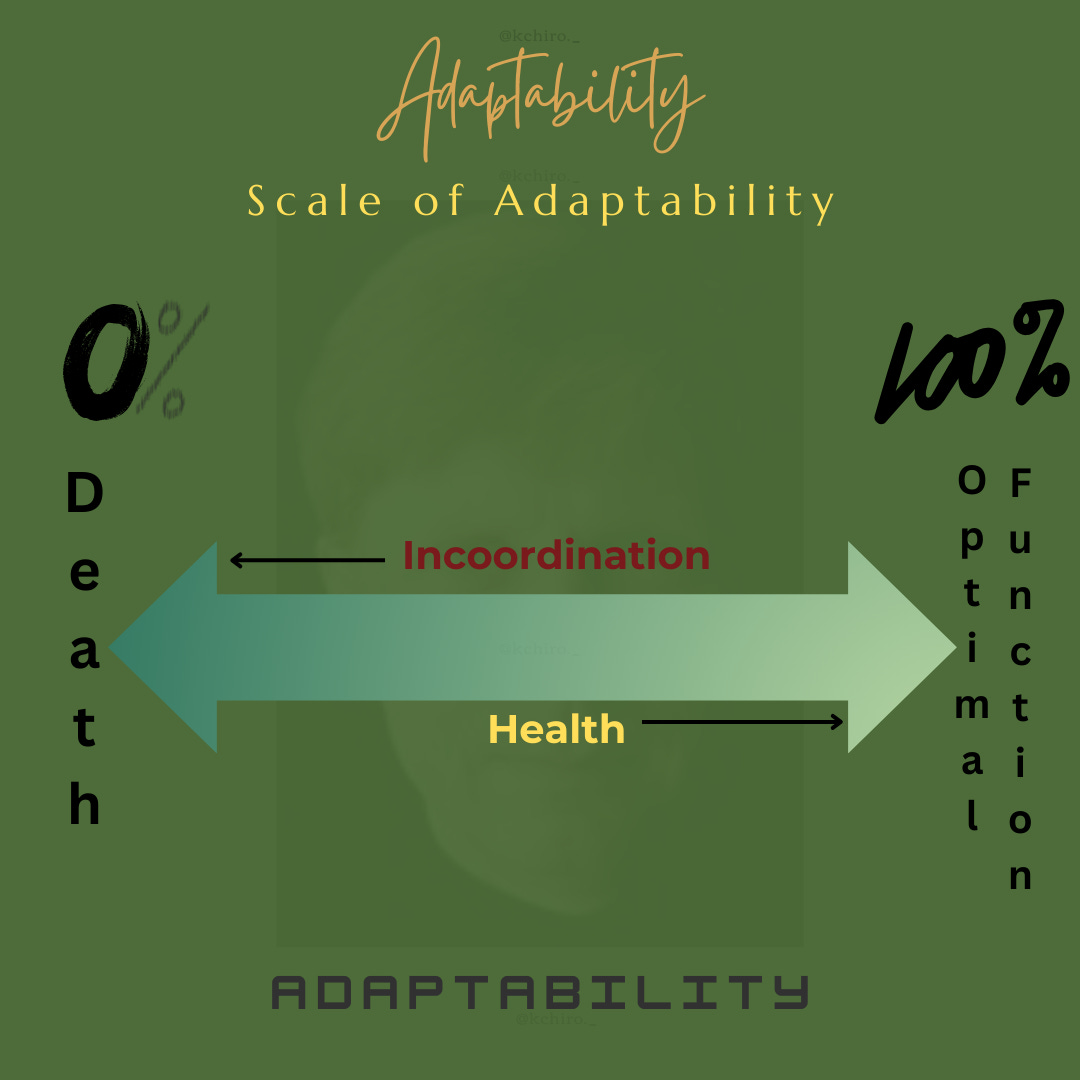
In the loss of ideal health, there are noted features on the path to death on the other end of this continuum.
At the right end of the illustration, we have 100% adaptability in the optimal state of health. Barring sudden demise - from e.g. accident or injury - the path towards death is often marked by particular points of lost health.
Once you are no longer at a state of optimal health you have entered a prenosological state.
Once you leave the state of optimal health you are no longer healthy, regardless of the presence or absence of symptoms at the onset.
Eventual symptomatic picture seen in deviations from health had the main cause of insufficient adaptability. If departure from health is based upon adaptability & not contingent upon expression of symptoms, this begs the question of the value of symptoms in health care.
Health then is the ability to adapt to environmental conditions both internal & external to the body.
The goal of adaptation is not to make a specific change, as one might set the thermostat in a room to increase the temperature to a specific point.
The goal is to restore the ability within the body to properly relate to its internal & external environments.

🔗 Useful Resource:
Textbook of Human Adaptability (2016) - Rob Sinnott
Textbook of Chiropractic Philosophy (2009) - Rob Sinnott
Chiropractic Textbook (1927) - R. W. STEPHENSON